



This therapist directory is offered in partnership with BetterHelp. If you sign up for therapy after clicking through from this site, HelpGuide will earn a commission. This helps us continue our nonprofit mission and continue to be there as a free mental health resource for everyone.
Need to talk to someone now? Find a crisis helpline
If you're a BetterHelp therapist with questions about your directory listing, please contact therapists@betterhelp.com
There so many different vitamins and mineral supplements available, it can feel overwhelming trying to decide what you should take. Here’s how to ensure you’re getting the right amounts of everything you need.
Adapted with permission from Making Sense of Vitamins and Minerals, a special health report published by Harvard Health Publishing.
Vitamins and minerals are essential nutrients because they perform hundreds of roles in the body. There is a fine line between getting enough of these nutrients (which is healthy) and getting too much (which can end up harming you). Eating a healthy diet remains the best way to get sufficient amounts of the vitamins and minerals you need.
Every day, your body produces skin, muscle, and bone. It churns out rich red blood that carries nutrients and oxygen to remote outposts, and it sends nerve signals skipping along thousands of miles of brain and body pathways. It also formulates chemical messengers that shuttle from one organ to another, issuing the instructions that help sustain your life.
But to do all this, your body requires some raw materials. These include at least 30 vitamins, minerals, and dietary components that your body needs but cannot manufacture on its own in sufficient amounts.
Vitamins and minerals are considered essential nutrients—because acting in concert, they perform hundreds of roles in the body. They help shore up bones, heal wounds, and bolster your immune system. They also convert food into energy, and repair cellular damage.
But trying to keep track of what all these vitamins and minerals do can be confusing. Read enough articles on the topic, and your eyes may swim with the alphabet-soup references to these nutrients, which are known mainly be their initials (such as vitamins A, B, C, D, E, and K—to name just a few).
In this article, you’ll gain a better understanding of what these vitamins and minerals actually do in the body and why you want to make sure you’re getting enough of them.
BetterHelp is an online therapy service that matches you to licensed, accredited therapists who can help with depression, anxiety, relationships, and more. Take the assessment and get matched with a therapist in as little as 48 hours.
Take Assessment HelpGuide is user supported. We earn a commission if you sign up for BetterHelp’s services after clicking through from this site. Learn moreVitamins and minerals are often called micronutrients because your body needs only tiny amounts of them. Yet failing to get even those small quantities virtually guarantees disease. Here are a few examples of diseases that can result from vitamin deficiencies:
Just as a lack of key micronutrients can cause substantial harm to your body, getting sufficient quantities can provide a substantial benefit. Some examples of these benefits:
Although they are all considered micronutrients, vitamins and minerals differ in basic ways. Vitamins are organic and can be broken down by heat, air, or acid. Minerals are inorganic and hold on to their chemical structure.
So why does this matter? It means the minerals in soil and water easily find their way into your body through the plants, fish, animals, and fluids you consume. But it’s tougher to shuttle vitamins from food and other sources into your body because cooking, storage, and simple exposure to air can inactivate these more fragile compounds.
Many micronutrients interact. Vitamin D enables your body to pluck calcium from food sources passing through your digestive tract rather than harvesting it from your bones. Vitamin C helps you absorb iron.
The interplay of micronutrients isn’t always cooperative, however. For example, vitamin C blocks your body’s ability to assimilate the essential mineral copper. And even a minor overload of the mineral manganese can worsen iron deficiency.
Water-soluble vitamins are packed into the watery portions of the foods you eat. They are absorbed directly into the bloodstream as food is broken down during digestion or as a supplement dissolves.
Because much of your body consists of water, many of the water-soluble vitamins circulate easily in your body. Your kidneys continuously regulate levels of water-soluble vitamins, shunting excesses out of the body in your urine.
B vitamins:
Vitamin C
Although water-soluble vitamins have many tasks in the body, one of the most important is helping to free the energy found in the food you eat. Others help keep tissues healthy. Here are some examples of how different vitamins help you maintain health:
Contrary to popular belief, some water-soluble vitamins can stay in the body for long periods of time. You probably have several years’ supply of vitamin B12 in your liver. And even folic acid and vitamin C stores can last more than a couple of days.
Generally, though, water-soluble vitamins should be replenished every few days.
Just be aware that there is a small risk that consuming large amounts of some of these micronutrients through supplements may be quite harmful. For example, very high doses of B6—many times the recommended amount of 1.3 milligrams (mg) per day for adults—can damage nerves, causing numbness and muscle weakness.
Rather than slipping easily into the bloodstream like most water-soluble vitamins, fat-soluble vitamins gain entry to the blood via lymph channels in the intestinal wall (see illustration). Many fat-soluble vitamins travel through the body only under escort by proteins that act as carriers.
Absorption of fat-soluble vitamins
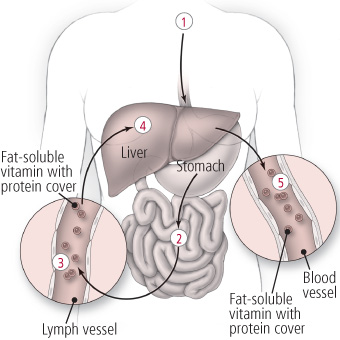
Fatty foods and oils are reservoirs for the four fat-soluble vitamins. Within your body, fat tissues and the liver act as the main holding pens for these vitamins and release them as needed.
To some extent, you can think of these vitamins as time-release micronutrients. It’s possible to consume them every now and again, perhaps in doses weeks or months apart rather than daily, and still get your fill. Your body squirrels away the excess and doles it out gradually to meet your needs.
Together this vitamin quartet helps keep your eyes, skin, lungs, gastrointestinal tract, and nervous system in good repair. Here are some of the other essential roles these vitamins play:
Because fat-soluble vitamins are stored in your body for long periods, toxic levels can build up. This is most likely to happen if you take supplements. It’s very rare to get too much of a vitamin just from food.
The body needs, and stores, fairly large amounts of the major minerals. These minerals are no more important to your health than the trace minerals; they’re just present in your body in greater amounts.
Major minerals travel through the body in various ways. Potassium, for example, is quickly absorbed into the bloodstream, where it circulates freely and is excreted by the kidneys, much like a water-soluble vitamin. Calcium is more like a fat-soluble vitamin because it requires a carrier for absorption and transport.
One of the key tasks of major minerals is to maintain the proper balance of water in the body. Sodium, chloride, and potassium take the lead in doing this. Three other major minerals—calcium, phosphorus, and magnesium—are important for healthy bones. Sulfur helps stabilize protein structures, including some of those that make up hair, skin, and nails.
Having too much of one major mineral can result in a deficiency of another. These sorts of imbalances are usually caused by overloads from supplements, not food sources. Here are two examples:
A thimble could easily contain the distillation of all the trace minerals normally found in your body. Yet their contributions are just as essential as those of major minerals such as calcium and phosphorus, which each account for more than a pound of your body weight.
Trace minerals carry out a diverse set of tasks. Here are a few examples:
The other trace minerals perform equally vital jobs, such as helping to block damage to body cells and forming parts of key enzymes or enhancing their activity.
Trace minerals interact with one another, sometimes in ways that can trigger imbalances. Too much of one can cause or contribute to a deficiency of another. Here are some examples:
The difference between “just enough” and “too much” of the trace minerals is often tiny. Generally, food is a safe source of trace minerals, but if you take supplements, it’s important to make sure you’re not exceeding safe levels.
Antioxidant is a catchall term for any compound that can counteract unstable molecules such as free radicals that damage DNA, cell membranes, and other parts of cells.
Your body cells naturally produce plenty of antioxidants to put on patrol. The foods you eat—and, perhaps, some of the supplements you take—are another source of antioxidant compounds. Carotenoids (such as lycopene in tomatoes and lutein in kale) and flavonoids (such as anthocyanins in blueberries, quercetin in apples and onions, and catechins in green tea) are antioxidants. The vitamins C and E and the mineral selenium also have antioxidant properties.
Free radicals are a natural byproduct of energy metabolism and are also generated by ultraviolet rays, tobacco smoke, and air pollution. They lack a full complement of electrons, which makes them unstable, so they steal electrons from other molecules, damaging those molecules in the process.
Free radicals have a well-deserved reputation for causing cellular damage. But they can be helpful, too. When immune system cells muster to fight intruders, the oxygen they use spins off an army of free radicals that destroys viruses, bacteria, and damaged body cells in an oxidative burst. Vitamin C can then disarm the free radicals.
Antioxidants are able to neutralize marauders such as free radicals by giving up some of their own electrons. When a vitamin C or E molecule makes this sacrifice, it may allow a crucial protein, gene, or cell membrane to escape damage. This helps break a chain reaction that can affect many other cells.
It is important to recognize that the term “antioxidant” reflects a chemical property rather than a specific nutritional property. Each of the nutrients that has antioxidant properties also has numerous other aspects and should be considered individually. The context is also important—in some settings, for example, vitamin C is an antioxidant, and in others it can be a pro-oxidant.
Articles and advertisements have touted antioxidants as a way to help slow aging, fend off heart disease, improve flagging vision, and curb cancer. And laboratory studies and many large-scale observational trials (the type that query people about their eating habits and supplement use and then track their disease patterns) have noted benefits from diets rich in certain antioxidants and, in some cases, from antioxidant supplements.
But results from randomized controlled trials (in which people are assigned to take specific nutrients or a placebo) have failed to back up many of these claims. One study that pooled results from 68 randomized trials with over 230,000 participants found that people who were given vitamin E, beta carotene, and vitamin A had a higher risk of death than those who took a placebo. There appeared to be no effect from vitamin C pills and a small reduction in mortality from selenium, but further research on these nutrients is needed.
These findings suggest little overall benefit of the antioxidants in pill form. On the other hand, many studies show that people who consume higher levels of these antioxidants in food have a lower risk of many diseases.
The bottom line? Eating a healthy diet is the best way to get your antioxidants.
Adapted with permission from Making Sense of Vitamins and Minerals, a special health report published by Harvard Health Publishing.

Eating right to look and feel your best at every stage of your life




Tips to help you and your family eat delicious, healthy food on a tight budget


Millions of readers rely on HelpGuide.org for free, evidence-based resources to understand and navigate mental health challenges. Please donate today to help us save, support, and change lives.
Donate to HelpGuide.org today